Posts

Showing posts with the label Macbeth

Macbeth Act 5

Even though I do feel bad for Lady Macbeth, I believe that this was already coming for her. Prior to act 5 she did not give a care in the world as to what has happened to any of these people. She was a selfish woman. I do understand, doing whatever one wants to get what they want out of life, but there also comes a cost with that. In the beginning of act 5, the reader sees Lady Macbeth having a  struggle with herself. Perhaps everything she has done has caught up with her. She now feels guilty when it is too late. Why is it now that she seems to be remorseful?  Why did she not think about all the options when she was telling her husband to do these foul things from the very beginning? She did it just for power and look at where she has ended up. It was all for nothing ultimately. She has driven herself so mad that she feels like she has to kill herself.

Macbeth Act 5

Image
I love the way that Macbeth and Lady Macbeth switch roles from the beginning to the end of the play. Initially, Macbeth is apprehensive and afraid to commit murder, but Lady Macbeth is assertive and confident in their abilities to be on the throne. By Act 5, Macbeth has become overly-confident in his security and fighting abilities, claiming that no man can strike him down because of his false interpretation of the witches prophecies. Lady Macbeth has taken to sleep walking and muttering about her bloody hands because of her overwhelming guilt and paranoia. This is especially ironic because earlier she told Macbeth that a little water would wash away the evidence, but she is walking around at night worrying about how to remove the stains. As Lady Macbeth unhinges, Macbeth takes on the role she initially played. Lady Macbeth's suicide is profound to me because I would have expected Macbeth to kill himself and Lady Macbeth to have been murdered based on the first two acts. https:/...

Macbeth Act 5

Image
Your conscience is so powerful at times that it can haunt you. Scene one shows the perfect representation of what happens when something is weighing heavy on ones conscience. In this scene Lady Macbeth is being observed for her sleep walking. While she was being observed the doctor saw that Lady Macbeth kept washing "blood" off her hands saying, "Out, damned spot, out I say!..." She began to feel guilty for the death of Duncan. Even though she didn't physically commit the murder she played a role in his death. No matter how much she scrubbed she could not get the smell off her hands, she asked, will her hands ever be clean and that all the perfumes of Arabia cant sweeten her hand. Why did she feel so guilty if she didn't commit the crime? http://www.istockphoto.com/photos/bloody-hand?excludenudity=true&sort=mostpopular&mediatype=photography&phrase=bloody%20hand

Macbeth

Image
http://www.bbc.com/travel/story/20151207-ecuadors-mysterious-walking-trees I thought that the prophecies of the witches were handled like a prophecy from an oracle in Greek literature. Where it was by some unthinkable actions and word play that eventually lead to the prophecies coming true. That lead to the whole theme of free will. I enjoyed how the witches prophesied that he would die when the woods moved to Dunsinane Hill. That came true because the soldiers brought the woods to him to hide the number of soldiers. The prophesy that Macbeth wouldn't be killed by a man born from woman came true in a weird way, where "Macduff was from his mother's womb untimely ripped" (5, 8, 19-20). He really should have heeded the first prophesy that said to beware Macduff.

Macbeth Act 3 & 4

"I will advise you where to plant yourselves, Aquaint you with the perfect spy o' th' time, The moment on 't, for 't must be done tonight..." (Act 3 scene 2 lines 148-150) Why couldn't Macbeth just commit the murder himself if he knew exactly what he wanted done to Banquo?

Macbeth 3&4

"Upon my head they placed a fruitless crown/And put a barren scepter in my grip,/Thence to be wrenched with an unlineal hand,/No son of mine succeeding."(Act 3, Scene 1,66-69)

Macbeth act 3

"If trembling I inhabit then, protest me The baby of a girl." (Act 3, scene 4, 127-128)

Macbeth 3&4

Image
"Naught's had, all's spent, Where our desire is got without content. 'Tis safer to be that which we destroy Than by destruction dwell in doubtful joy." (3.2.6-9) https://imgflip.com/i/1tsntt

Macbeth Act II

When Macbeth has the vision of the dagger it is very interesting to see how he reacts. He seems confused at first but not opposed to it. He actually asks to hold it. He is aware that it is a vision and that it is not real. He describes his mind as "feverishly excited", this implies that he wants to kill Duncan and that he is looking forward to it. He has this whole conversation with himself and ends up coming to terms with killing Duncan so that he can be king. I find this scene to be very interesting. The reader is able to know what Macbeth is thinking and understand him better.

Macbeth Act II

Image
Act II of Macbeth highlights Lady Macbeth's cunning and manipulative personality. After the murder, Macbeth is becoming paranoid and already showing signs of regret for killing the King. Meanwhile,  Lady Macbeth is able to stay clam and orchestrate the rest of their plan while her husband is panicking, being mindful not to leave any loose ends that could incriminate the two. However, Macbeth also shows his ability to manipulate others based on the way he reacts to the news of the King's murder the next morning, even though he was losing his mind the night before. Image from the Wikipedia page on drama

Macbeth

Act 2 of Macbeth led me to thinking about the crime solving strategies of Macbeth's time. Macbeth and Lady Macbeth craftily blame the death of the king on his servants simply by placing the murder dagger wisely. The princes Malcolm and Donalbain are soon blamed because they fled the area. The court of assumptions is the judge of this murder already. The entire situation reminds one of the importance of even basic crime solving practices. At Macbeth's point in time it seems the only way to reliably catch the true criminal is to catch someone in the act.

Guilt and assumptions

Image
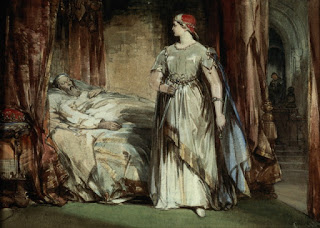
Lady Macbeth, contemplating the sleeping King Duncan. image from Wikipedia           In act 2 scene 2, Macbeth tells his wife that the two servants had awoken before he could kill them  (lines 30-44). Included in this section of dialogue is more proof that he knows is actions are wrong "As they had seen me with these hangman's hands, List'ning their fear. I could not say "Amen" when they did say "God bless us". (lines 37-40) On line 44, Macbeth says that the Amen "stuck in his throat". what he did was murder, and he knows it so deep within the core of his being that his voice rebels at this false act of piety. His later inability to sleep is a further expression of this guilt.       Later, in scenes 3 and 4, we learn that Macbeth's claim that he discovered the servants in the act of murder and killed them, has been accepted, and that Donalbain and Malcolm are suspected of ordering the assassination, since they fled out of fear...

Macbeth Act 1

First Witch      All hail, Macbeth! Hail to thee, Thane of Glamis! Second Witch      All hail, Macbeth! Hail to thee, Thane of Cawdor! Third Witch      All hail, Macbeth, that shalt be king hereafter! Page 17: Act I/ Scene 3/ Lines 51-53

Macbeth Act 1

the love that follows us sometime is our trouble , which we still thank as love (act 1 sc 6 line 14-15)

Q/Q

Macbeth "Your children shall be kings." Banquo "You shall be king." Lines 89-90 Act 1. SC 3 Ross "The King hath happily received, Macbeth,/The news of they success,and ,when he reads/ Thy personal venture in the rebels' fight,/His wonders and praises do contend/Which should be thine or his."(21) Lines 93-97 Act 1 SC 3

Macbeth Act I

"I am settled and bend up/ Each corporal agent to this terrible feat./ Away, and mock the time with fairest show./ False face must hide what the false heart doth/ know." (1.7.92-96)

Macbeth

"The Prince of Cumberland! That is a step On which I must fall down or else o'erleap, For in my way it lies. Stars, hide your fires; Let not light see my black and deep desires." (1.4.55-58)

Macbeth

“Time and the hour runs through the roughest day.” (Act 1, scene 3, Line 164)

Macbeth

Image
"And oftentimes, to win us to our harm, The instruments of darkness tell us truths, Win us with honest trifles, to betray's In deepest consequence.-- Cousins, a word, I pray you." (Act 1, Scene 3, 135-139) https://101books.net/2014/09/23/book-74-appointment-in-samarra/

Macbeth

"And the very ports they blow; All the quarters that they know I' th' shipman's card. I'll drain him dry as hay. Sleep shall neither night nor day Hang upon his penthouse lid. He shall live a man forbid. Weary sev'nnights, nine times nine, Shall he dwindle, peak, and pine. Though his bark cannot be lost, Yet it shall be tempest-tossed." Macbeth  Act 1. Sc. 3 Lines 16-26