Posts

Showing posts with the label Beowulf

Quote

"When the dragon stirred, strife was renewed; he slithered alone the stones, stark-hearted he found his enemy's footprint --- he had stepped too far in his stealthy skill, too close to the serpent's head. Thus can an undoomed man easily survive wrack and ruin, if he holds to the Ruler's grace and protection!" (lines 2287-2293)

Quote

"His courage did not melt, nor did his kinsman`s legacy," (2628)

Beowulf Quote

"This is not your path,/ nor proper for any man except me alone/ that he should match his strength against this monster,/ do heroic deeds." ( Beowulf , 2532-2535) If it is no one else's path but yours, Beowulf, then should you fall, would the world fall too?
Beowulf "No more soaring about in the skies/ at midnight, preening in his precious treasures,/ showing his face - he fell to the earth/ through that war-commander's handiwork." (Beowulf 2832-2835)

Beowulf

" With heavy spirits they mourn their despair, the death of their lord;  and a sorrowful song sang the Gettish woman, with hair bound up, for Beowulf the king, with sad cares, earnestly said that she dreaded the hard days ahead,the times of slaughter, the host's terror, harm and captivity. Heaven swallowed the smoke." (Lines 3148-3155)

Beowulf's Dragon Arc... Yay.

Image
"His heart was grieving,/restless, ripe for death -- the doom was immeasurably near/that was coming to meet that old man,/seek his soul's treasure, split asunder/his life and his body; not for long was/the spirit of that noble king enclosed in its flesh" (2419-2424) Link for picture: http://www.alamy.com/stock-photo/long-shadow-digit-number-four.html

Quote

Image
Image by Erin Schwagerl                                        "Then day was departed to the delight of that worm; he did not linger on the barrow wall, but took off burning in a burst of flames." - Beowulf , Lines 2306-2309

Sudden Reiteration of virtue? Quotation.

Image
The Sutton Hoo helm, a well known Anglo-Saxon artifact excavated from the Sutton Hoo ship-burial in England photo credit; myself, i took this at the British Museum in 2015. From Beowulf, page 207 line 2538 to 2541. Then that brave challenger stood up by his shield, stern under his helmet, bore his battle-shirt under the stone-cliffs, trusted the strength of a single man -- such is not the coward's way.

Beowulf Q+Q

Image
http://www.fictorians.com/2017/03/06/its-dangerous-to-go-alone/ "far-off lands/are better sought by one who is himself good" (1838-1839).

Beowulf: Quotes and questions

"When the great beast began to seize him, he remembered his mighty strength, the ample gifts which God had given him, and trusted the Almighty for mercy, favor and support; thus he overcame the fiend, subdued the hellish spirit." (page 131 line 1269-1274)

Beowulf response 1: the role of rings

Image
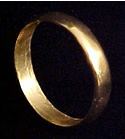
A simple golden ring image source: https://doubtfulsea.com/tag/ring/      On line 35, during the description of Scyld, king of the Scyldings and grandfather to Hrothgar, is refered to as "dispenser of rings". On line 350, Wulfgar referes to Hrothgar by a similar epithet, "giver of rings". what is the significance? The purpose of rings and similar jewelry is to provide a means of displaying wealth in a very conspicuous manner. After a battle or some other significant event, a king might give such items as a reward for loyal or conspicuous service. A man with many rings of silver and gold would be wealthy indeed. Giving a ruler like Scyld or Hrothgar an epithet like "ring giver"  implies benevolence to their people and generosity to their allies and to those who serve them well, in addition to their wealth and ability to rule.

Beowulf

Image
(Source: Erin Schwagerl) After listening to the Seamus Heaney audio narration of the Beowulf clips, I felt I had a completely different understanding of the reading. The flow provided by listening to an audio narration made the story make a lot more sense in my head. The experience reminded me of being a child and my dad reading me a bedtime story. I could visualize the scenes and I understood what action was happening to each character. The first time I read line 817, I thought it was one of the human soldiers whose shoulder had been ripped apart. Then when listening to the audio version I realized Beowulf had caused this injury to the great monster. The words were the same; however, hearing the words delivered audibly brought me contextual clarity I had not found in reading the passage.

Beowulf Paragraph 1

Image
W hile reading  Beowulf  the idea of a  superhero versus a monster is prominent.  Superhero's  are used to show strength and leadership. Writers  utilize  the  monsters  to counteract the  superheroes  and show the contrast in  each  character ' s traits and actions . Showing this difference allows for the reader to relate to both the superhero and monster within the story. In Beowulf,  Grende l  is the monster and Beowulf  kills  him. Readers enjoy superheroes because they are relatable and resemble the "perfect" person. The superhero shows extreme leadership, for  example  S uperman and B atman are prime examples of leaders that readers can aspire to. Depending on the individual Batman may be  preferred  over Superman or  vice  versa, this shows how the superhero is determined by the reader. These characters; Superman, Batman, and Beowulf, all portray the traits of a ...

Beowulf

Image
While reading the right hand side of my book, I often tried to compare to the left and find anything I could recognize, but this depressed me after a few pages, and I just read the translation. I have been trying to follow what religion Beowulf and the Danes practice, but I am still confused. There are several references to Christianity, or Monotheism at the least, but there are also references to pagan worship. In lines 180-181 it is stated that "they did not know the Maker,/ the Judge of deeds, they did not know the Lord God," which implies the existence of only one god, the creator (Beowulf.) However, in lines 175-178 we learn that "At times they offered honor to idols/ at pagan temples, prayed aloud/ that the soul-slayer might offer assistance/ in the country's distress" which indicates praying to the devil (Beowulf.) It also describes Grendel as being a descendant of Cain, which is clearly a Christian reference, given that Cain was the first son of Adam and...

Quotes & Questions post Info

Image
What makes certain lines from a text jump off the page and fill you with interest and curiosity? Why do some passages carry more meaning and significance than others? For example, Satan in Milton's Paradise Lost tells us: Here at least We shall be free; th' Almighty hath not built Here for his envy, will not drive us hence: Here we may reign secure, and in my choyce To reign is worth ambition though in Hell: Better to reign in Hell, than serve in Heav'n. (Book I, ll. 258-263) This phrase, "better to reign in Hell than serve in Heaven," has caught on - it's almost a proverb. And it's come to represent Satan's character more so than any other line from this massive and miraculous poem. Plus, it just sounds awesome. In short: there's a lot to discuss about this passage, isn't there? Book and tablet photo by Engin_Akyurt on Pixabay.com On days that we don't have paragraphs due, we'll have what I call Quotes and Questions. Yo...

Paragraph post info

Image
A paragraph is an elusive thing: it seems like something really obvious, something we have known how to write since elementary school. But how do you define a paragraph? How can you tell a good paragraph from a lackluster one? And how do you write the kind of paragraphs that make it easier to communicate your ideas to your reader? Simply put, a paragraph is a group of sentences that develop a single idea. That’s it. The correct length for a paragraph is however many sentences are required to introduce the idea of the paragraph, explain that idea, provide any necessary examples or evidence, explain that evidence, wrap up your idea, and (sometimes) transition into your next idea. However, you have to stick to a single idea! If you can’t write a clear, well-developed paragraph, you can’t write a good paper, a clear memo, a convincing email, or an enticing cover letter. Those who master the paragraph are ready to take on the world! Home Office photo by Free-Photos on Pixabay.com...