Posts

Gullivers Travels Book 4

Image
I found it really interesting that Gulliver's main goal was to learn the language of the Houyhnhnms. He was so interested in these horse people. I'm not going to lie, I probably would be interested in them to because they aren't something that I would be used to seeing. Gulliver comes off very selfish because he leaves him pregnant wife to go on another voyage. Like, what kind of man leaves his wife, who is carrying their child, to sail across the sea? I know this book is suppose to be complete satire, but who is Jonathan Swift making fun of by making the house people 'smarter' than humans? That's kind of funny because I was once told that animals are way smarter than we might think.

Humans and horses

So apparently the Houyhnhnms are horse people that are more intelligent then men. I find this funny and quite disturbing. Is swift trying to take a jab at human intelligence compared to animal intelligence? Are humans the less intelligent vessels on earth?either way I'm tired of the compatibility involving humans and other beings. I get it ok?! Humans are not the only thing in the universe. The sun does not shine because of humans. We are part of something much bigger.

Gulliver’sTravels paragraph

The last place, the land of the Houyhnhnms is probably Gulliver’s favorite and most  ideal place to live, which possibly makes it a utopic society for him? It is surprising to me because one usually associates their home as a place of comfort and happiness. But that is not the case for Gulliver. Gulliver associates Houyhnhnms as a place that he can call his home. In my opinion the land of Houyhnhnms is not anything special . Gulliver has misperceived Houyhnhnm land.  The fact that Gulliver thinks this way demonstrates that he has a lot of issues going on. He seems selfish to me. He has a pregnant wife and child at home but does not want to return to them. And when he does, he is disgusted with his own family. He should be disgusted with himself for the way he is acting.

Gullivers travels

I found the last trip that Gulliver went on to be a little disturbing. Especially the part when he finally gets home. He hates everyone so much and no longer refers to humans as such but calls them Yahoos.  He also neighs as he speaks and since he hates everything that looks like a Yahoo he is disgusted by his own family. There’s probably some reason he ended it the way he did but I don’t know what that reason is.

Oroonoko Paragraph - Questions and Braveheart?

Image
I'm a bit confused about specifically two things in this reading. The first is when Behn says, "I ought to tell you that Christians never buy any slaves but they give 'em some name of their own..." (2205). How exactly does that work? Unless I'm reading this wrong, this reads as if Christians are super in denial about slavery. The second thing that confuses me is at the bottom of 2205, where we're told that the slaves that Oroonoko comes across are the very same slaves he sold into slavery, yet here they are throwing themselves at his feet? Why would they do this? I do have to say that calling Oroonoko Caesar is basically foreshadowing of when the slaves betray him later on in the story and his fate of death. Also, the ending of this story is giving me some serious vibes of Braveheart , what with the disembowelment, draw and quartering, and the refusal to live in under the rule of another. .gif from Braveheart (http://media1.giphy.com/media/m12GiqBQywgbS...

Resilient faith?

In the text Oroonoko is promised freedom over and over again without any follow through or sign of commitment to that guarantee. He's constantly assured that one day he will be free and his son won't be born into slavery but there is little evidence to support this promise. Still after all the deceit Oroonoko surrenders and accepts this. I'm curious why he still takes a man who has proven himself untrustworthy at his word. It think its very possible that he uses his hope as a way to cope and avoid dealing with the situation he's trapped in. In the end we see that all the promises were truly empty and that there was never any true intent of freeing him. Even though I know these promises where a manipulation tactic I still wanted to have that hope, like Oroonoko, that there was a chance.

Oroonoko Paragraph

While reading the second half of "Oronoko," I admit that I had trouble following the story at times. However, I feel that despite that problem, I was able to understand the main points that the author is trying to get across. The idea of a noble man and his wife, expecting a child, constantly tormented by the idea of being in servitude is upsetting, to say the least. Especially with the heartbreaking end to which Oroonoko and his wife are met. I understand that the author is trying to convey the brutality of slave masters, which I feel she did pretty well, but I found myself lost and sometimes troubled by the way she seemed to often objectify Oroonoko, making him seem like a valuable commodity that would be even more valuable if he was free. I wonder what points were supposed to really resonate with white women.

Kill Hero = Maintain Anger

The ending of Oroonoko almost accomplished a feeling of "at least the bad guys didn't completely win" until our great hero was quartered and mailed. I truly do not understand why he did not spite-suicide himself like he convinced Imoinda to. He still had the physical energy to kill the first soldier to approach him, so why not use that energy on self sacrifice? Perhaps he could have used his body to communicate a message if not with words with symbolism. My theory is that the author couldn't let the underdogs win entirely (or the sympathy would be lost? or the roused anger at real world injustices would have been hampered), and thus the descriptive and upsetting defeat of the favored character.

Changing views, issues of the "they are just like us, but..." mindset

Image
"Oroonoko kills Imoinda" from the program of a 1776 performance of the stage adaptation by Thomas Southerne. https://en.wikipedia.org/wiki/Noble_savage       It is interesting to not that Trefry only takes serious interest in Oroonoko after learning he spoke English and noted his physical appearance (already summarized as "only issue is his color"). Only when he learns of Oroonoko's status as royalty does Trefry express genuine sympathy and indignation at Oroonoko's enslavement (page 2204).      As good as the intention behind the writing is, this means of generating sympathy is problematic. It places the emphasis of value on ways an individual is "more like a white person" rather than emphasizing the humanity of Africans as a whole. It is easy to see the progression from "this individual who has learned European languages and has facial features that do not look like the stereotype is worthy" to the situation which caused the horror...

Paradise Lost

For Hot, Cold, Moist, and Dry, four champions fierce Strive here for mast'ry and to battle bring Their embryon atoms. (line 897-900)
"Thither full fraught with mischievous revenge Accursed, and in a cursed hour, he hies.' (Book II Lines 1054-1055)

Paradise Lost, Book II, Part II

"So he with difficulty, and labour hard Moved on; with difficulty and labour he: But he once pass'd, soon after, when man fell, Strange alteration; Sin, and Death, amain, Following his tract (such was the will of heaven) Pav'd after him a broad and beaten way Over the dark abyss, whose boiling gulf Tamely endur'd a bridge of wondrous length, From hell contained, reaching th'utmost orb Of this frail world; by which the spirits perverse With easy intercourse pass to and fro, To tempt or punish mortals, except whom God and good angels guard by special grace." (Lines 1021-1033)

What the Everfucking Fuck is Wrong with this Family????

Image
"...Out of thy head I sprung! Amazement seized All th' host of Heav'n. Back they recoiled afraid At first and called me "Sin" and for a sign Portentous held me. But familiar grown I pleased and with attractive graces won The most averse (thee chiefly) who full oft Thyself in me thy perfect image viewing Becam'st enamoured and such joy thou took'st With me in secret that my womb conceived A growing burden." (Book 2, Lines 758-767) "...and swifter far Me overtook, his mother, all dismayed, And embraces forcible and foul Engend'ring with me of that rape begot These yelling monsters that with ceaseless cry Surround me as thou saw'st, hourly conceived And hourly born as sorrow infinite To me." (Book 2, Lines 791-798) And then these hell-hound children of hers crawl back into her womb and chew on her insides? What the fucking shit, Milton? (Image from Meme Generator - https://memegenerator.net/img/instances/400x/2...

Book 2

Image
Book 2 opens up with Satan debating on whether he and his demons should try and fight God again to overthrow his power. I don't understand why they are still trying because they failed once already. Do they not understand that they cannot be greater than God? This section gives the arguments of the four demons on what they think they should do. Satan asks his demons what they think their best option would be: go to war or give it up. Why doesn't Satan just come up with the plan himself? Beelzebub says, "...seduce them to our party that their God may prove their foe and with repenting hand abolish His own works" (2.368-370). He believes that he can get God's people to follow them and leave their ruler. What are they thinking? https://www.google.com/url?sa=i&rct=j&q=&esrc=s&source=images&cd=&ved=0ahUKEwjK7Pf2o7_XAhXH7BQKHUxhBfMQjRwIBw&url=https%3A%2F%2Fvriley.edublogs.org%2Ftag%2Fparadise-lost%2F&psig=AOvVaw0iWeZ9N6g5F9DfRA-h2JeN...

Satan the Comet

“On th’ other side Incensed with indignation Satan stood Unterrified and like a comet burned That fires the length of Ophiucus huge In th’ arctic sky and from his horrid hair Shakes pestilence and war.” 706-711 Notes for understanding: Ophiucus is a large constillation of a man holding a snake. Also comets were frequently thought to be the cause of war or other bad events. On the other side Feeling really angry and frustrated about the unfairness of things satan stood there He was unafraid and like a big firey disaster causing comet With enough power to go very far and cause a lot of bad-ness.

Pomp and Circumstance and Demons.

Image
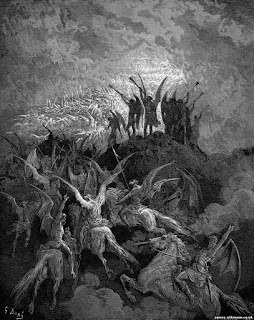
"Satan in Council" Ninteenth century woodblock print by Gustave Doré "The Stygian council thus dissolved and forth In order cam the gran infernal peers. Midst came their mighty paramount and seemed Alone th' Antagonist of Heav'n, nor less Than Hell's dread Emperor with pomp supreme And God-like imitated state. Book 2, lines 506-511

book 2

Satan is very amusing in the passage, he ponders the impossible. The passage states, "Satan, their chief, undertakes alone the voyage, is honored and applauded." This is referring to the possibility of another battle with heaven. It's so amusing that the fallen angels would select Satan after he led them straight to hell before. But it's hilarious that Satan would take this cursed position yet again. It makes many wonder if Satan is insane or truly enjoying his damned eternity.  Maybe he believes he can achieve since here is no where left to fall.

Book 2

In the beginning of book two, Satan debates whether or not another battle would be hazardous for the recovery of heaven.I question Satan and his motives. Does he really care about searching the truth about the prophecy? It seems to appear that in this situation as it is weighted so much, Satan is a "hero".I find it interesting when he is considered as their “chief” if he thinks that he is on the same level as God? Before book two we see Satan questioning God’s power and how he possibly does not understand it. Does Satan really have the people's best interest at heart or is he doing this for his own personal reasons?I am a little confused as to what he is trying to do.

Book 2

Image
The demons argue about what their next move should be and I thought that Mammon's idea to build up Hell to be as beautiful and industrious as Heaven was pretty cute. I didn't think that any of the other demons would be on board with that plan, given that it seems like the easiest way to impress God and be rewarded with his forgiveness. Also, it doesn't seem very realistic... How are you going to put out a fire that consumes an entire lake? Hell is described as a huge bummer and to say that they can just clean it up and have it looking like Heaven seems like a stretch. However, the idea of corrupting an entire race that God loves the most, is definitely more of a plan to humiliate God. I had it in my head that humans already existed (because I thought angels were dead humans) so this part made a lot more sense to me when I realized that God hadn't yet created mortals. Are the original angels by God's side just spirits? Sorry for being ignorant :/  https://upload...

book 2 for Paradise Lost

Image
It's weird reading about demons who are trying to figure out how to deal with their situation. When I usually think of demons I think of beings who enjoy the flames and torment. In Paradise Lost he makes them out to be suffering. Yet this suffering doesn't affect their ability to have a council and decide what to do with their current situation. These fallen angels are very human-like. I guess that explains why the fallen angels say that humans are "created like... us though less in pow'r and excellence" (349-350). I am enjoying the 'fresh' perspective on demons and angels. http://thepinoycatholic.blogspot.com/2014/01/council-of-trent-happened-450-years-ago.html